Best AI visibility tools: 9 options compared by data and API access
Compare the best AI visibility tools by the engines they check, what each result contains and how you get the data into your own reports

The best AI visibility tool is the one whose data fits where your reports already live. Every tool below checks whether AI answers mention your brand. They differ on which engines they ask, what a single result contains, where the questions come from and whether you can pull the data out through an API or only read it in their app.
heeb publishes this blog and is one of the nine options. Everything we say about the other eight comes from their own product pages, help centers, API references and pricing pages, read on October 14, 2026 and linked below.
Quick summary
If your team already pays for Ahrefs, Semrush or Similarweb, start with their AI visibility module, because it sits next to your search data. If you report to clients from dashboards, Otterly.AI, LLM Pulse, Peec AI and SE Visible are built around tracked prompts, exports and Looker Studio. If you need the raw answers in your own database or product, check which plan includes the API: Ahrefs, LLM Pulse, Otterly.AI and SE Visible document one on paid plans, Peec AI and Profound keep it for Enterprise, and heeb is only an API.
Five questions to ask before you choose
- Which engines does it check? ChatGPT and Google's AI features are close to universal. Claude, Copilot, Grok and Perplexity coverage varies, and some tools sell extra engines as add-ons.
- What does one result contain? Look for a mention flag, the brand's position, sentiment, the cited pages and the full answer text. Without the text, you cannot check why a result changed.
- What does "position" mean? Some tools rank brands in the order the answer names them. Semrush ranks your domain among the cited sources. Both are useful, but they answer different questions.
- Where do the questions come from? Most tools track prompts you write and rerun them on a schedule. Ahrefs and Similarweb also report on large prompt sets they collect themselves.
- How do you get the data out? A dashboard and CSV export suit a monthly report. An API or MCP server suits a warehouse, a client portal or an automated alert.
AI visibility tools compared
Read from each vendor's own pages on October 14, 2026. Plans change often, so open the pricing links before you budget.
| Tool | Engines named in its docs | Brand data per result | Full answer text | Getting the data out | Billing model |
|---|---|---|---|---|---|
| Ahrefs Brand Radar | ChatGPT, AI Overviews, AI Mode, Gemini, Perplexity, Copilot; Claude for custom prompts; Grok listed, but no new Grok data is being collected | Mentions, share of voice, cited pages and domains | Yes, in the API | App, export, API and MCP | Ahrefs plan plus the Brand Radar add-on |
| heeb | OpenAI, Anthropic, xAI, Perplexity, Google AI Mode | Mention flag, ranked brand mentions, sentiment label, sources and citations | Yes, per model | API, MCP server, n8n node | Prepaid credits, no subscription |
| LLM Pulse | ChatGPT, Perplexity, Gemini, AI Mode, AI Overviews; Claude, Copilot, Grok and others as paid add-ons | Mentions, sentiment per answer, citations | Yes, in the API | App, CSV, Looker Studio, Power BI, MCP; API from the Scale plan | Subscription, 14-day trial |
| Otterly.AI | AI Overviews, ChatGPT, Perplexity, AI Mode, Gemini, Copilot, Claude | Mentions, brand rank, sentiment, cited URLs | Yes, CSV or JSON export | App, CSV and JSON, Looker Studio, MCP; API from the Standard plan, with read-only or read and write keys | Subscription, 7-day trial |
| Peec AI | ChatGPT, Perplexity, Gemini, AI Mode | Visibility, position, sentiment, sources | In the app | App, CSV, Looker Studio connector, MCP; API on Enterprise | Subscription, free trial |
| Profound | ChatGPT, Gemini, AI Overviews on the trial plan; Enterprise sets its own list | Visibility, sentiment, citations, query fan-outs | Yes, in the API | App, exports; API on Enterprise | Trial and Enterprise plans |
| SE Visible | ChatGPT, Gemini, Perplexity, AI Mode, AI Overviews | Visibility, share of voice, sentiment, average position, cited sources | Yes | App, CSV, SE Visible API (beta) | Subscription with prompt limits, free trial |
| Semrush AI Visibility Toolkit | ChatGPT Search, Google AI Mode, Gemini | Visibility, mentions, your domain's position among citations, cited pages | Snapshot in the app | App, Google Sheets and CSV export; not in the Semrush API yet | Toolkit subscription |
| Similarweb AI Brand Visibility | ChatGPT, Perplexity, Gemini, AI Mode | Visibility share, sentiment, citations down to the URL | Latest answer per prompt | App | Subscription, free trial |
Strengths and limits of each tool
Ahrefs Brand Radar
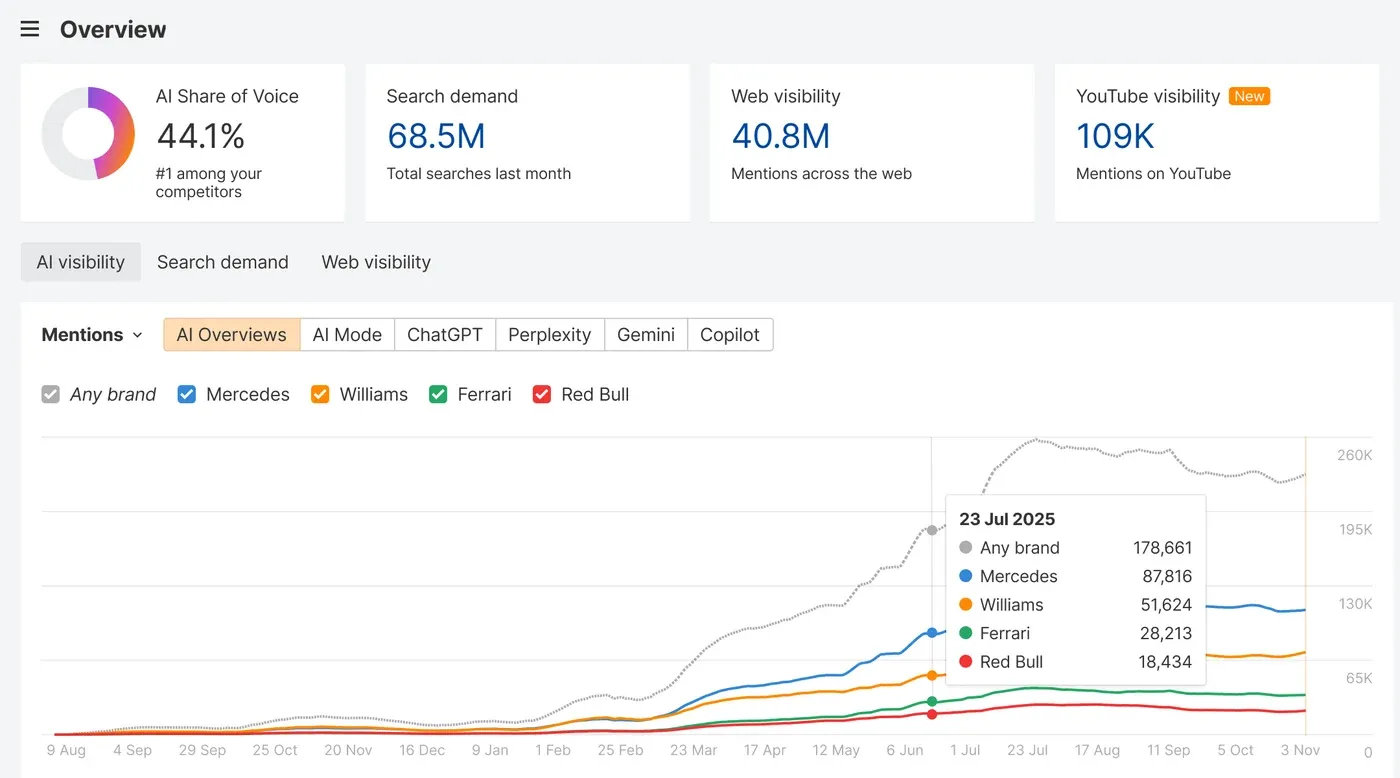
Product image from the Ahrefs Brand Radar page, October 14, 2026.
Brand Radar reports on Ahrefs' own set of more than 475 million search-backed prompts and on custom prompts you add, which its product page says are free on every paid Lite plan and above. The AI Responses endpoint returns the question, the full response, the links it used and, for ChatGPT and Perplexity, the search queries the engine ran.
That prompt set makes Brand Radar a good fit for finding questions you did not think to track. The API filters answers by whether your pages were cited, retrieved but not cited, or not found at all, which is a useful split for content work. We found no sentiment metric on its Brand Radar page or in that API reference. Grok is still in its engine list, but Ahrefs' help center says it is temporarily unable to gather new Grok data, so do not count on Brand Radar for current Grok monitoring.
heeb
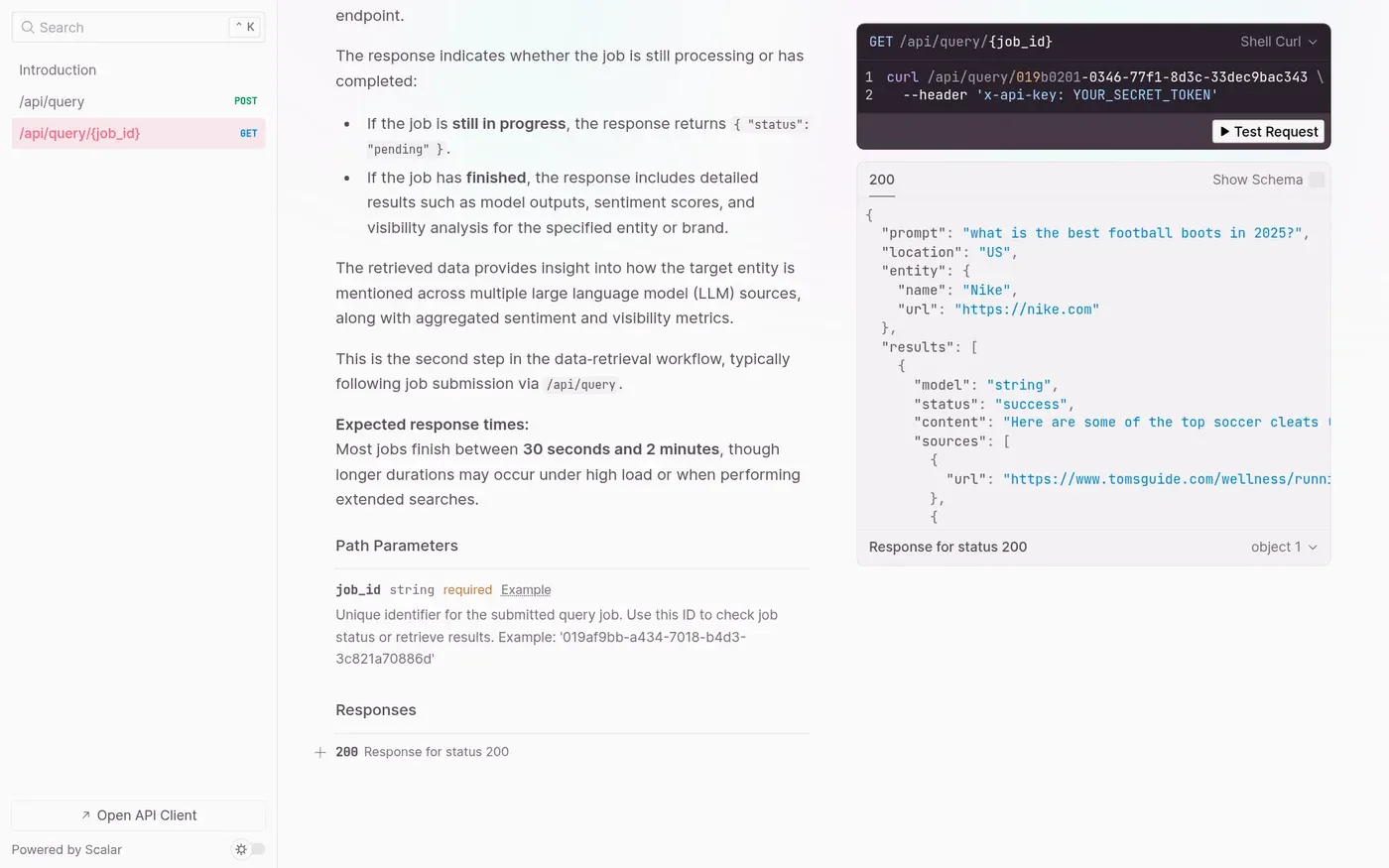
The result endpoint in the heeb API reference, October 14, 2026.
heeb is an API for brand mentions in AI answers, with no reporting dashboard. One request sends a question to the model families you pick and returns each answer's text, the brands it names in order, its sources and citations, a mentioned flag and a sentiment label, plus visibility and sentiment scores across the models. You can also call it through an MCP server or the n8n node.
The limits follow from that design. heeb runs a question when you send it, so a weekly report needs a scheduler on your side, such as the n8n workflow. The mentioned flag and sentiment label describe the one brand you send; competitors appear in the ranked mentions, but their sentiment needs its own request. It does not cover Gemini, Copilot or AI Overviews.
LLM Pulse
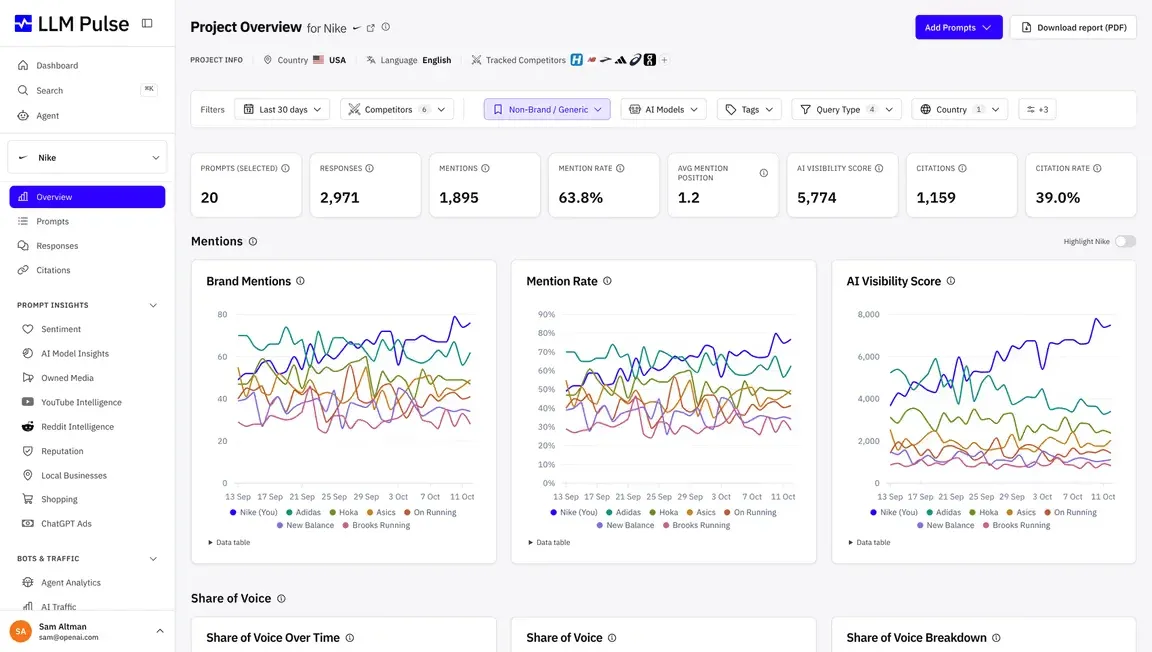
Product image from the LLM Pulse home page, October 14, 2026.
LLM Pulse's pricing page includes five engines on every plan: ChatGPT, Perplexity, Gemini, AI Mode and AI Overviews. Its home page lists Claude, Copilot, Grok and several regional engines as paid add-ons. Sentiment is scored on each answer that mentions your brand, and you choose daily or weekly tracking.
It offers more ways to move data than most tools here: CSV output, Looker Studio, Power BI, webhooks, an MCP server and a REST API whose answers endpoint returns full model responses. The API is available on Scale plans and above.
Otterly.AI
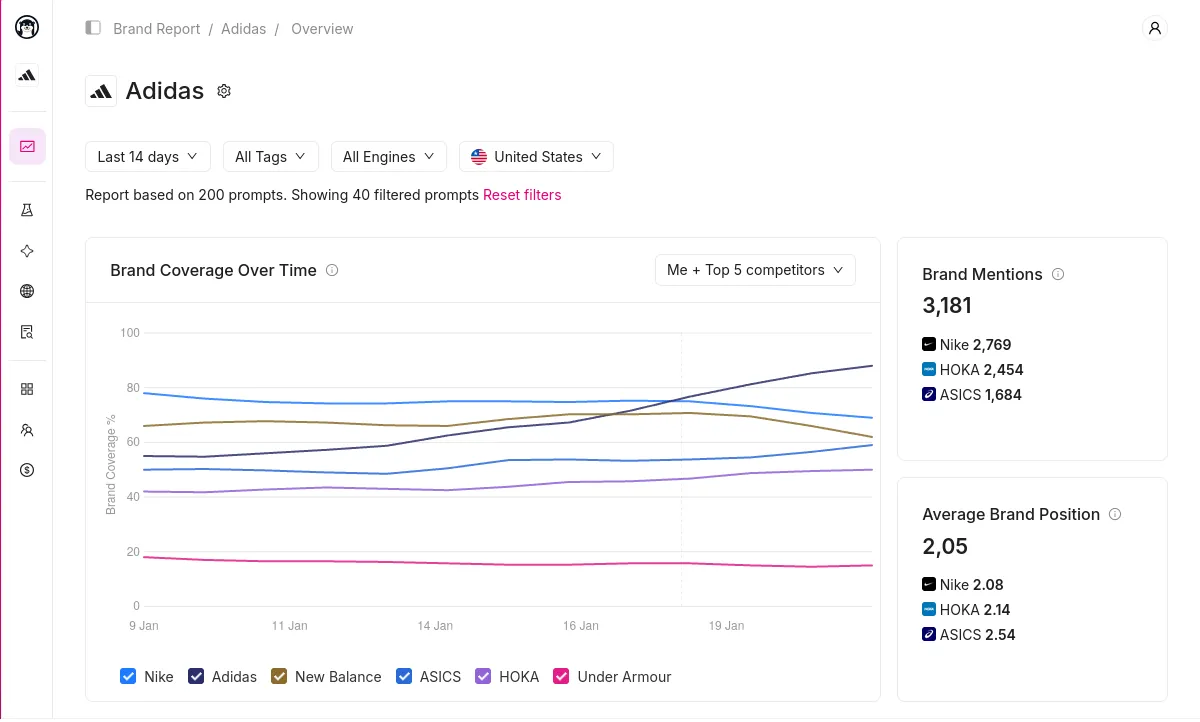
Otterly.AI Brand Report overview with sample data.
Otterly.AI tracks seven engines, including Copilot and Claude. Its help center says Claude is checked through Anthropic's API with web search, not through the Claude app, so those results can differ from what a Claude user sees.
Its export page lists CSV exports of prompts and citations and a raw answer export in CSV or JSON on all plans. The API returns mentions, citations, share of voice and sentiment, and is included from the Standard plan up with a monthly request allowance. Admins issue read-only keys or read and write keys. A read and write key can also create and update reports, prompts and tags, and run GEO audits on demand, so you can script the setup as well as the reporting.
Peec AI
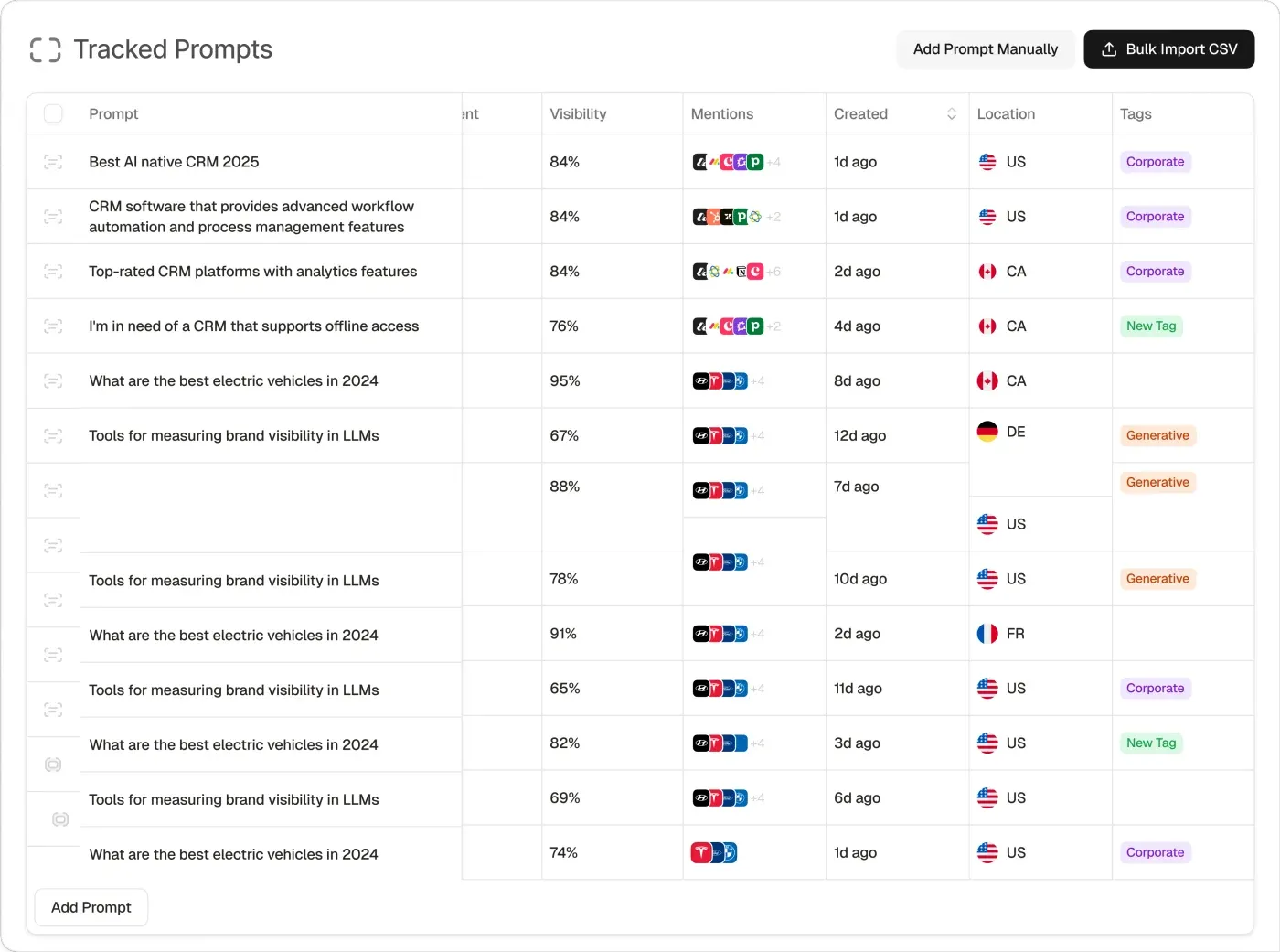
Product image from the Peec AI home page, October 14, 2026.
Peec AI's documentation frames its data as visibility, position and sentiment, and treats the sources AI answers cite as the place to act. Its pricing page lists a Looker Studio connector, CSV exports and an MCP server, and plans differ in how many engines and prompts are active.
The API documentation says API access is limited to Enterprise customers. The same docs warn that API-collected answers can cite different sources from the ones real users see, which is a fair caution for every tool on this page, heeb included.
Profound
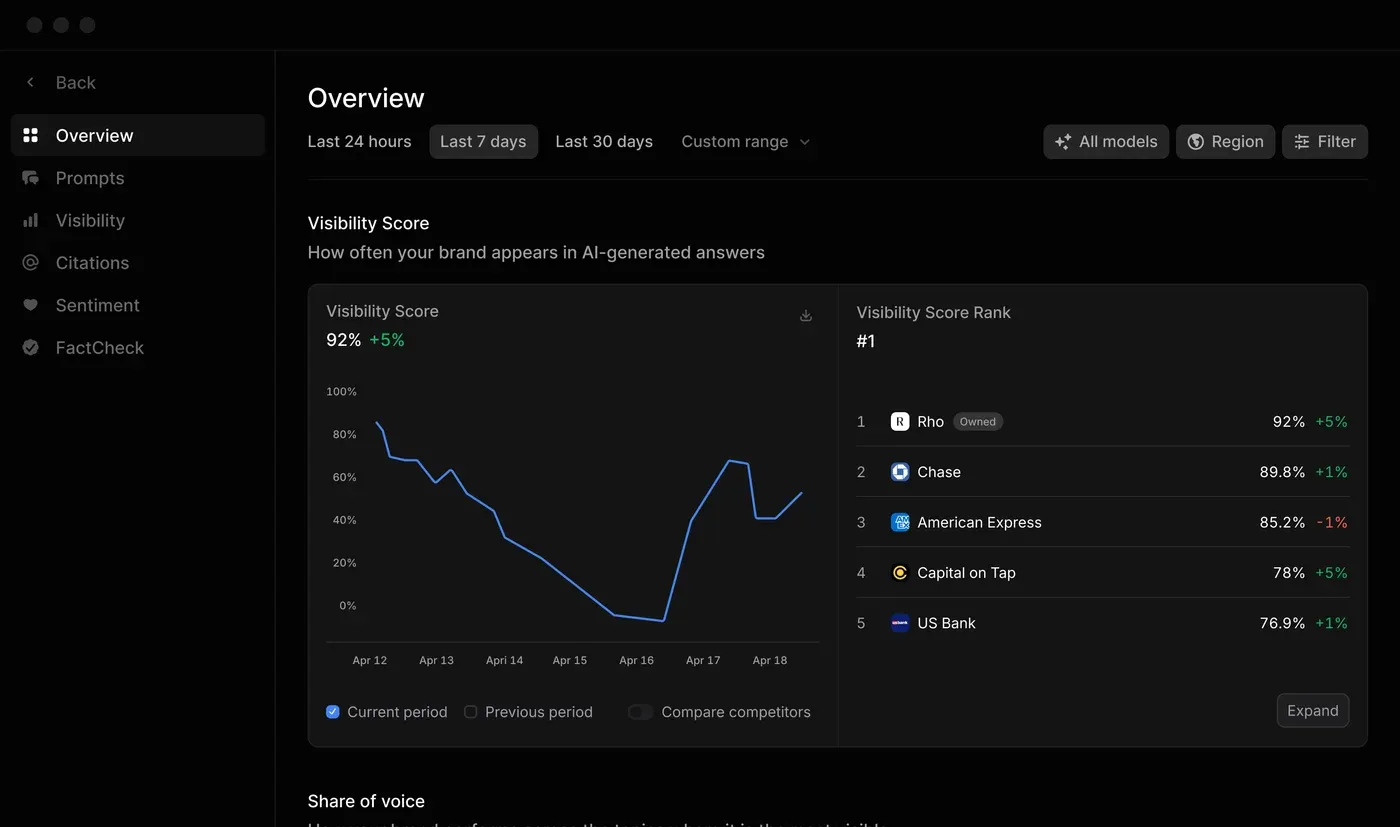
Product image from Profound's Answer Engine Insights page, October 14, 2026.
Profound's REST API has report endpoints for visibility, citations, sentiment and query fan-outs, and an answers endpoint with model responses, mentions and citations. The same page says the API is available on the Enterprise plan.
Its pricing page shows two plans. The trial tracks 50 prompts daily for seven days in ChatGPT, Gemini and Google AI Overviews, and the Enterprise plan adds exports and the API. Profound suits a large team that also wants its AI content tools and can buy the Enterprise tier.
SE Visible
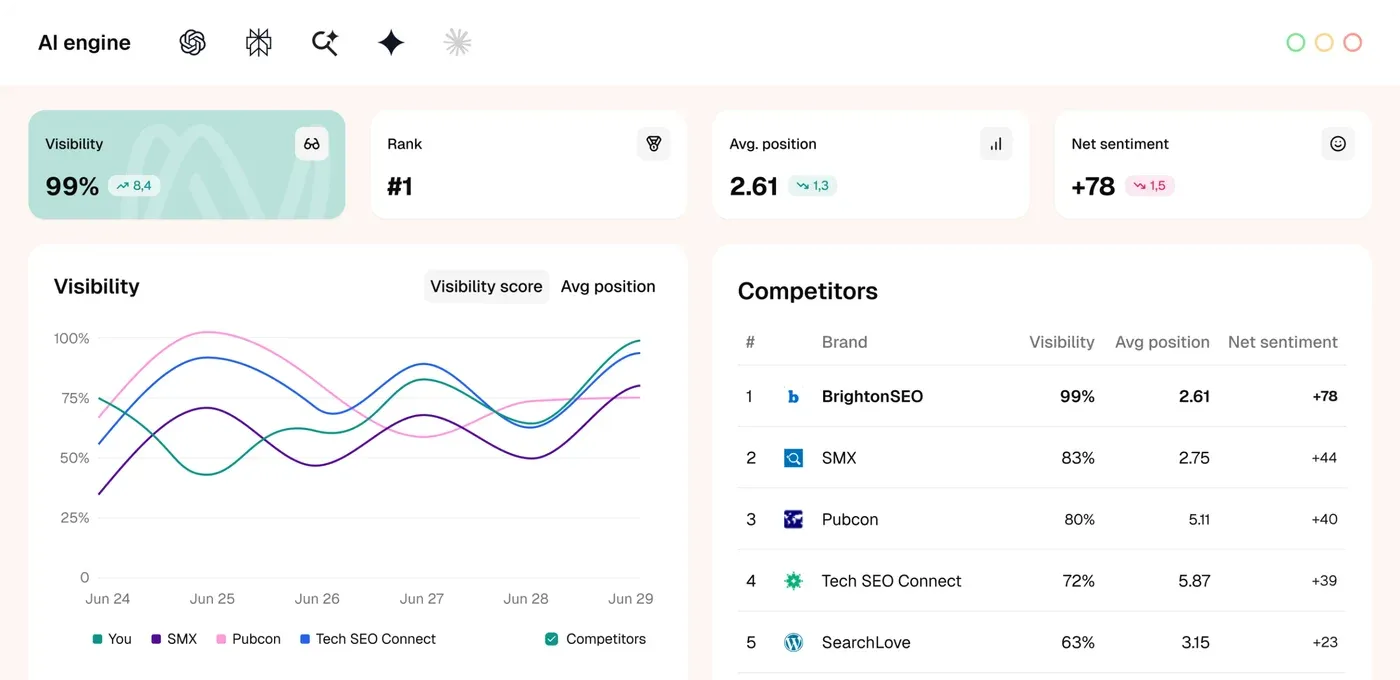
Product image from the SE Visible home page, October 14, 2026.
SE Visible is SE Ranking's AI visibility product. Its site covers ChatGPT, Gemini, Perplexity, AI Mode and AI Overviews, with daily updates and CSV export. The SE Visible API, marked beta, manages projects and returns prompt results with sentiment and brand mentions, plus visibility, share of voice, sentiment and average position.
Each project tracks one primary brand in one country and language, with competitors and their aliases attached. That suits agencies that report per client and per market.
Semrush AI Visibility Toolkit
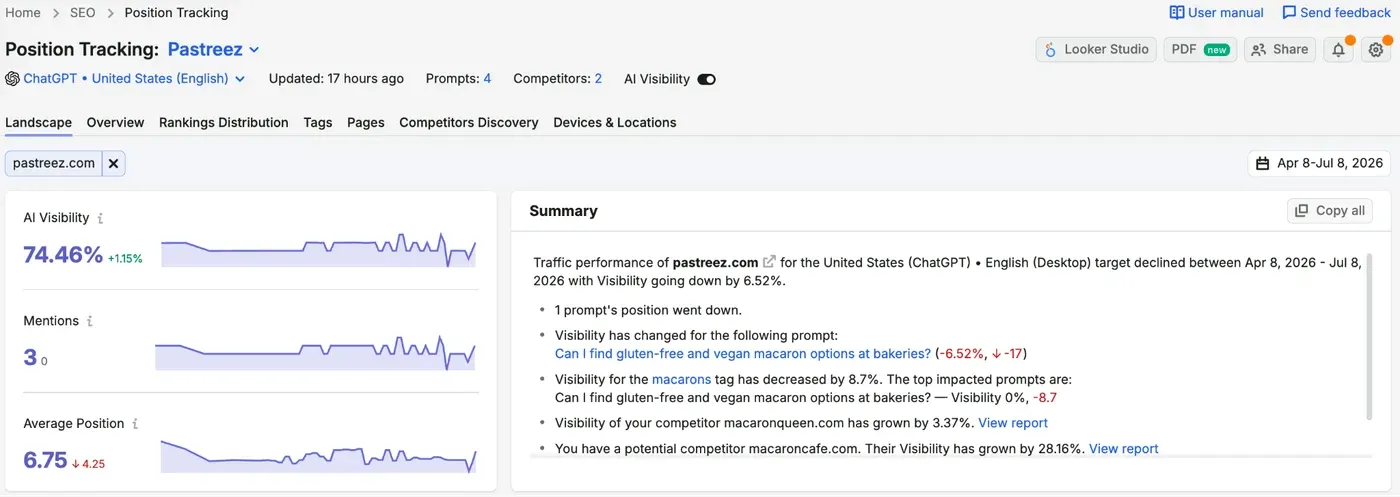
Screenshot from Semrush's Prompt Tracking guide, October 14, 2026.
Semrush's Prompt Tracking checks a custom prompt set daily in ChatGPT Search, Google AI Mode and Gemini, next to your Google rankings. Its position metric ranks your domain among the cited sources. In AI Mode, the answer itself counts as position 1 and the citations count from 2, so this is a citation ranking, not the order in which the answer names brands.
The Sources report lists every cited domain and page. Semrush's own dashboard guide says prompt-level and cited-page data are not available through the Semrush API yet, so you move them with Google Sheets exports, which you can schedule by email.
Similarweb AI Brand Visibility
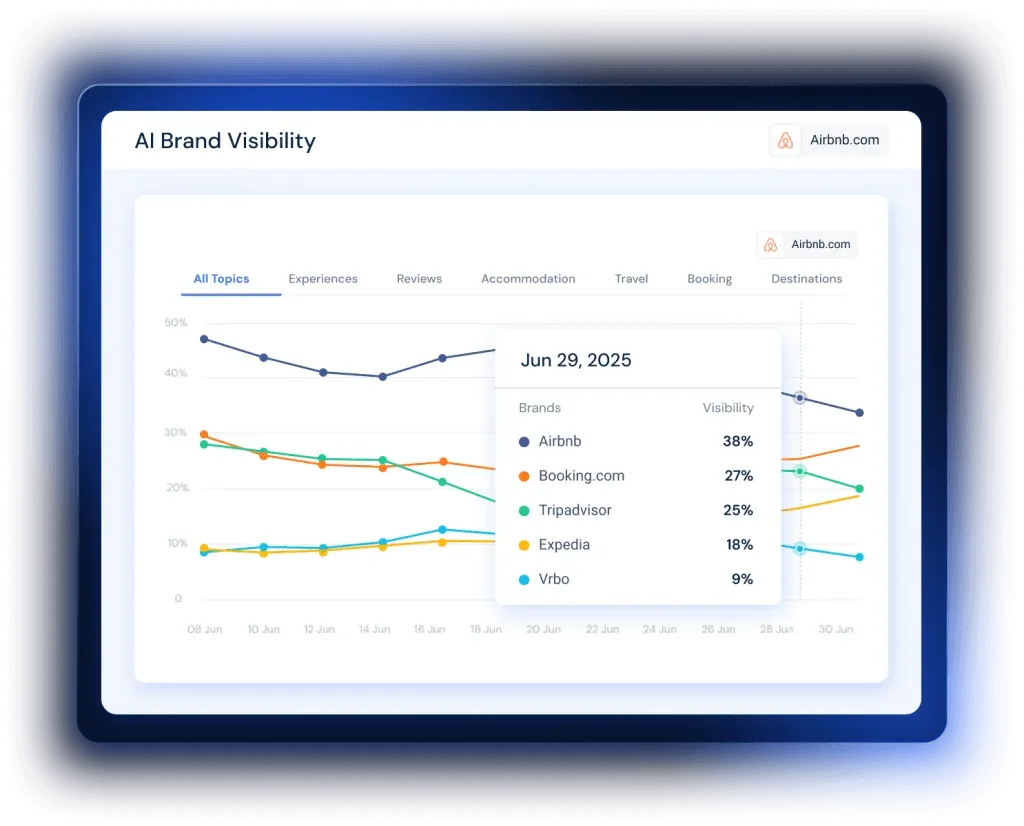
Product image from Similarweb's AI search page, October 14, 2026.
Similarweb's AI search pages describe visibility as the share of AI responses that mention your brand, with sentiment filters, citations down to the exact link and a prompt view with the latest answers. Its prompt analysis shows questions that people ask about your topics rather than only prompts you write, and the same product reports referral traffic from AI assistants.
It suits teams that already use Similarweb for market and traffic data. Its AI search page links to Similarweb's general data API, but that page does not mention AI visibility, prompt or citation data, so plan on working in the app.
Which tool fits which team
- You already pay for a search suite. Use Ahrefs Brand Radar, the Semrush AI Visibility Toolkit or Similarweb, so AI results sit next to your rankings and traffic. Choose Ahrefs if you want an API today.
- You send monthly client reports. Otterly.AI, LLM Pulse, Peec AI and SE Visible track prompts on a schedule and connect to Looker Studio or export to CSV.
- You want the answers in your own database or product. Compare Otterly.AI, SE Visible and LLM Pulse for API access on tracked prompts, and heeb for on-demand requests that return each answer, its ranked mentions and its citations as JSON.
- You need Claude or Grok in the set. heeb, Otterly.AI and Ahrefs (custom prompts) cover Claude. For current Grok answers, heeb queries xAI models directly and LLM Pulse sells Grok as an add-on; Ahrefs lists Grok but says it is not gathering new Grok data for now.
- You want to start without a subscription. heeb uses prepaid credits and gives new accounts free credits for a first test. LLM Pulse, Otterly.AI, Peec AI, SE Visible and Similarweb offer free trials.
Next step
Write five questions your buyers ask before they know your brand, then run them through two shortlisted tools on the same day and in the same country. Compare the answer text, not only the scores. If sentiment matters most, the sentiment API comparison goes deeper on how each API labels it, and the AI search visibility guide explains how to define mention rate before you track it.

Written by Elias Vance
Ready to build your next AI app?